You Already Have a Chief of Staff. It's You, and You're Doing It for Free.
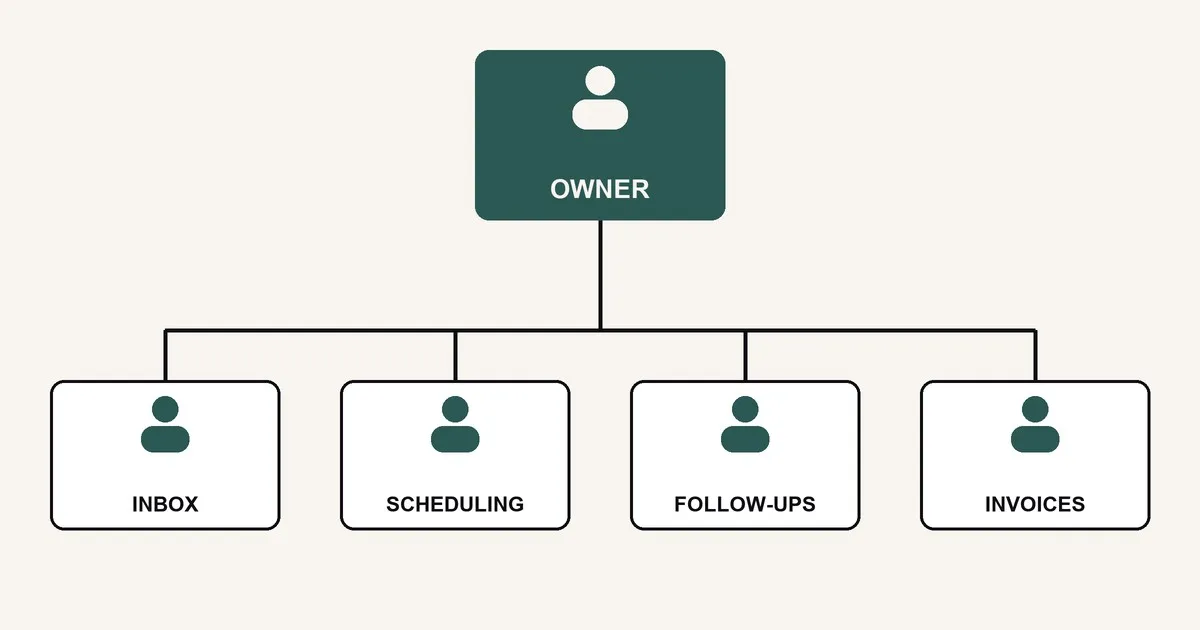
There is a definition making the rounds in the industry conversation right now, from a fractional chief of staff who does this work with executives, and they have written the cleanest plain-language description of the job I have seen.
Their core point: a chief of staff is not a glorified assistant. An assistant manages your day. A chief of staff manages your priorities. One protects your calendar. The other protects your focus.
Then they give the job four parts. A chief of staff turns strategy into execution, taking the goals that live in the leader's head and translating them into plans, owners, and follow-through, and catching things when they start to slip. A chief of staff creates clarity, making sure the right people have the right context at the right time. A chief of staff gives the leader room to lead, quietly absorbing everything else so the leader's best energy goes to the small number of decisions and relationships only they can carry. And a chief of staff manages what falls between the cracks: the important work that belongs to no department and keeps getting pushed.
They are right about all of it. I want you to sit with what that list means if you own a small business.
Because here is the thing nobody says to the owner-operator: you already have a chief of staff.
It's you.
You are the one holding the strategy in your head and trying to turn it into jobs, invoices, callbacks, and payroll. You are the connective tissue between your inbox, your texts, your truck, your kitchen table, and whoever is waiting on you. You are the one who catches what falls between the cracks, except you catch it at 11 PM, in bed, when your brain finally hands you the thing you forgot. The role, done well, takes a dozen open loops off a leader's shoulders. You carry a hundred, and you carry them in the same head you run the business with.
They end with a generous note: you don't necessarily need a full-time hire to get this support. True. But run the math honestly. A real chief of staff is a $150,000-a-year hire. A fractional one is a serious monthly retainer. The one-truck contractor, the two-person shop, the owner whose business lives on his phone: that door is closed to him, and he knows it, so he does the job himself and calls it normal.
That is the actual problem in small business right now. Not discipline. Not hustle. Staffing. The owner is unstaffed, so the owner becomes the staff, and the owner is currently the middleware of his own life, the human layer moving information between tools that refuse to talk to each other.
So here is the adaptation their definition makes possible, and I think it multiplies the value of the original idea. Those four jobs are a job description. And a job description can be built.
What if the chief of staff was a system you build from tools you already own, configured to do those same four jobs at owner scale?
Strategy into execution: everything enters through one door instead of twelve, and comes out the other side as owned tasks with dates, not as a pile you re-read every morning. Clarity: the system holds the context, so the plan lives in one place and not in your memory of three different inboxes. Room to lead: you start the day with a brief, the day's actual priorities in order, instead of starting it by digging. Between the cracks: follow-ups, renewals, and leads stop depending on you remembering them, because the system watches the cracks for you.
And the part that keeps you the owner and not the employee of your own tool: the system works inside guardrails you set. Nothing sends, books, or spends until you say yes. You are still the captain. You have just stopped also being the entire crew below deck.
What the built version cannot do, and should never pretend to: it has no judgment earned over years, no relationships, no skin in the game, and it will not tell you a hard truth across a desk. Those stay yours. They were always the work only you can do. That is the whole point of the third job on that list: the chief of staff exists so the leader can finally spend himself there.
They close by asking how a leader knows when it's time. For an executive, the answer is a hiring decision. For an owner, I think the answer is simpler. It's time when the business runs on what you can hold in your head, and your head is full.
You already have a chief of staff. The only question is whether you keep being him for free, or build the version that works for you.
Conceived and directed by David Heyburn. Built and narrated by his AI team.